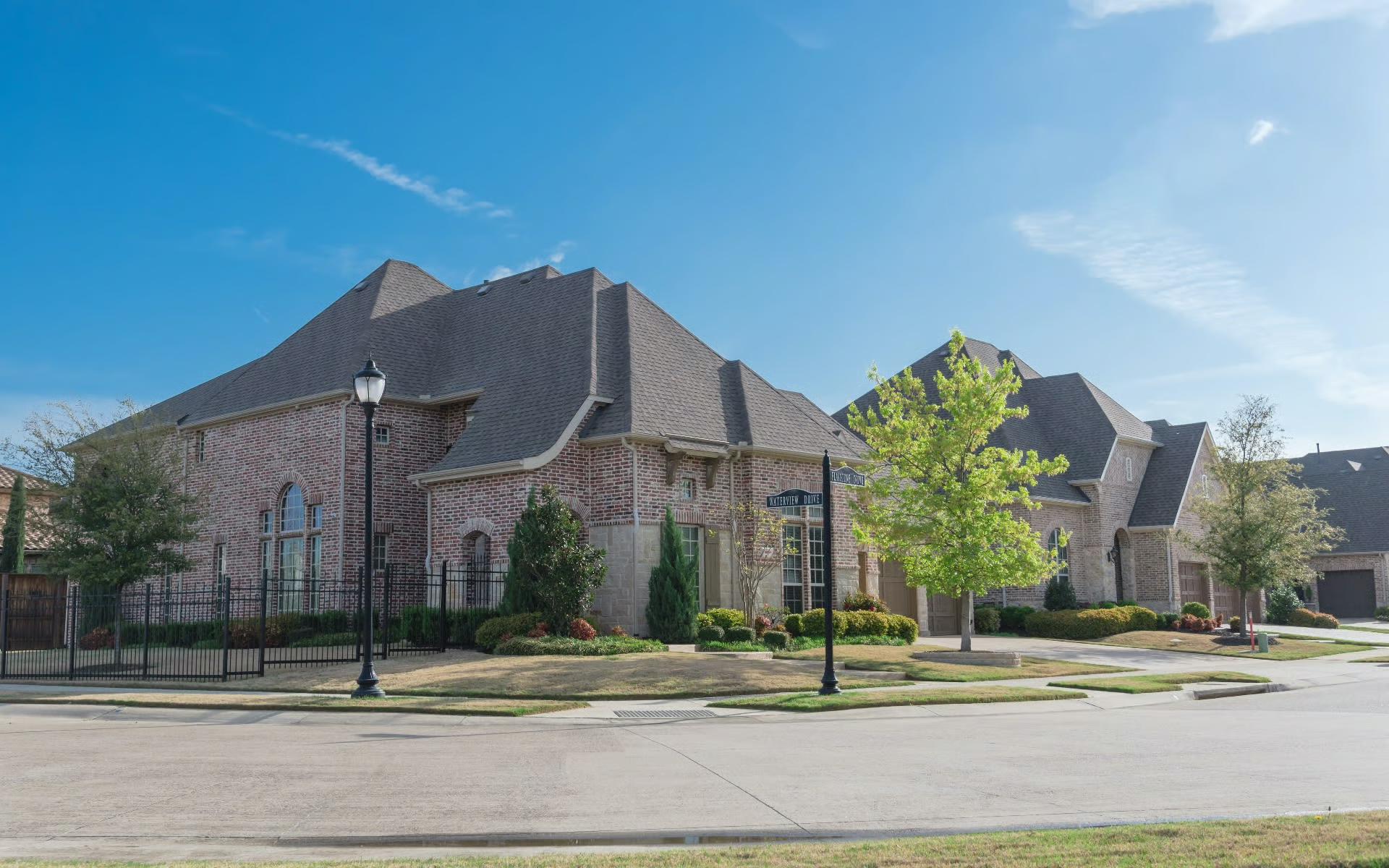
Is the New Braunfels and San Antonio market cooling—or just normalizing?
Quick Answer
Late March 2026 looks less like a headline-driven “up or down” market and more like a strategy market across New Braunfels, San Antonio, and the Hill Country: homes are taking longer to move, buyers have more choices, and pricing is being decided neighborhood-by-neighborhood (and sometimes street-by-street). The fastest wins right now come from treating each area as a micro-market and making decisions based on competition, days-on-market, and monthly payment math—not 2021 expectations.
For trusted guidance on the New Braunfels and Hill Country Real Estate Market, contact Cody Posey Real Estate – an expert local real estate agent working with buyers and sellers to succeed in today’s changing market.
The Complete Picture
If you’ve been watching the New Braunfels real estate market and thinking, “Why do I keep hearing two totally different stories?” you’re not imagining it. In 2026, the market has enough inventory and enough buyer selectiveness that outcomes are being decided by details: condition, price band, incentives, school zones, and whether a home feels like the best option compared to the next three a buyer can tour this weekend.
Here’s the simplest way I frame it: New Braunfels, San Antonio, and the Hill Country are not one market. They’re a collection of micro-markets. A home in 78130 that is move-in ready and priced cleanly can still attract strong activity, while a similar-priced home that needs updates (or competes head-to-head with a builder offering rate buydowns) may sit. That’s why a citywide “median” number can be informative, but it’s not a pricing strategy for your specific neighborhood.
On the San Antonio side, February reporting from SABOR (as summarized by Texas Public Radio) described a slower sales pace and longer marketing timelines, even while prices held up: sales were down year-over-year, homes averaged around 102 days on market, and inventory sat a little over five months—close to what many consider a balanced market (often cited around six months). Translation: buyers aren’t “stuck,” but they’re also not forced to waive everything just to get a contract.
In New Braunfels, the story has an extra layer: new construction competition. When builders are offering closing cost credits, upgrades, or rate buydowns, a resale listing can feel overpriced even if it’s only slightly above comps—because buyers compare monthly payment and cash-to-close. That’s why I keep coming back to one theme: affordability math and positioning matter more than ever.
Key Insights
Before we get tactical, I want you to walk away with a decision framework you can actually use. The goal isn’t to memorize stats—it’s to know which signals change leverage and timing, and which ones are just noise. Use these insights as your “filter,” then apply them to your neighborhood, your price band, and your goals.
-
Longer days-on-market is a leverage signal, not a panic signal
For the broader San Antonio–New Braunfels region, Realtor.com inventory metrics published through FRED show a February 2026 median days-on-market figure of 79 for the CBSA. When that’s the median, buyers have time to inspect, compare, and negotiate—and sellers need a clean value story from day one. Mini-example: if a home has been sitting well beyond the local median and it’s not uniquely special (lot, view, upgrades, location), it’s usually a candidate for either a price adjustment or a terms adjustment (credits, repairs, or both).
-
New Braunfels pricing is pocket-driven (and the “median” can mislead)
Public dashboards are useful, but they’re not a substitute for comps. For example, Redfin’s New Braunfels dashboard showed a February 2026 median sale price around $307,000 (about -5.5% year-over-year). That can happen even when some neighborhoods are stable—because the mix of what sold changed (more entry-level homes, more builder closings, fewer high-end resales). Mini-example: if your neighborhood has limited new-build competition and strong owner occupancy, your pricing may behave very differently than a citywide median shaped by builder volume.
-
San Antonio is behaving more “balanced,” which means preparation wins
Texas Public Radio’s recap of SABOR’s February numbers described a market with more flexibility: inventory a little over five months, homes taking longer to sell, and buyers still paying close to asking when homes are priced right. Mini-example: two similar homes can have wildly different results depending on launch execution—one gets showings and a clean contract in the first two weekends, the other drifts for 60+ days and ends up negotiating from a weaker position.
-
ZIP-level differences in New Braunfels matter (78130 vs 78132)
Recent local reporting summarizing Four Rivers Association of Realtors data highlighted that 78130 and 78132 can move differently at the same time—sales counts and under-contract activity don’t always rise and fall together. Mini-example: if you’re selling in 78132 and the buyer pool is thinner for your price band, you may need sharper pricing and stronger marketing to reach the right buyer quickly; in 78130, demand may be deeper but more price sensitive, making incentives or credits more effective than a stubborn list price.
-
Rates may ease, but payment math still runs the show in 2026
The Texas Real Estate Research Center forecast for the year ending summer 2026 put 30-year fixed rates in a roughly 6.0%–6.4% range into the fall. That’s not “cheap money,” so buyers shop payments. Mini-example: a seller who offers a targeted closing cost credit that supports a rate buydown can sometimes create a bigger buyer response than a small price cut—because the buyer feels it every month.
Market Reality
Here’s what I’m seeing when you translate the data into real decisions: buyers are willing to move fast when a home is clearly the best option at its price, but they’re not willing to overpay just to “win.” That’s why you’ll see both of these things happen in the same week: a well-positioned listing gets multiple showings and a strong offer, while another listing down the street sits because it’s priced like the market is still frantic.
For sellers, the biggest mistake right now is assuming the market will “forgive” an optimistic launch price. In a faster market, you can sometimes start a bit high and let urgency pull you down. In a balanced-ish market, buyers interpret a high list price as a warning sign, not an invitation to negotiate. And once a listing accrues days on market, the first question buyers ask (out loud or in their head) is, “What’s wrong with it?”
For buyers, the biggest mistake is negotiating without a plan. Leverage is real right now—but it’s not unlimited, and it’s not evenly distributed. The best homes (great condition, strong neighborhood pull, priced correctly) still get action. The leverage shows up most reliably when (1) a home has been sitting longer than the local norm, (2) it has obvious repair or update needs, or (3) it’s competing with a builder who is setting the “payment expectation” with incentives.
And zooming out: your timing should be driven by your personal math and your risk tolerance, not by trying to call the exact bottom or top. If you’re selling, the question is whether you can protect equity through strategy—pricing, preparation, and negotiation—despite longer market times. If you’re buying, the question is whether you can buy a home that fits your life with terms that keep your payment sustainable, and then hold it long enough for the move to make sense.
Action Steps
- Buyers: set a payment ceiling first. Decide what monthly payment feels comfortable (including taxes and insurance), then shop homes based on total payment impact—not just list price. If you want help running fast comparisons, start with New Braunfels home search and let’s narrow the best options.
- Buyers: use days-on-market as your negotiation trigger. When a listing is sitting beyond the local norm, that’s where closing cost credits, repairs, and price negotiations become most realistic. The goal isn’t to “win” a discount—it’s to improve your risk profile and your monthly payment.
- Sellers: price to your true competition (including builders). Pull your best closed comps, then compare your home to the best active alternatives a buyer can see right now. If you’re losing on value, adjust price, condition, or terms until you’re the obvious choice.
- Sellers: protect your first 10–14 days. If showing volume is weak or feedback repeats “overpriced,” don’t wait 45 days for the market to punish you. Make one decisive correction early while you still control the story.
- Both: get a micro-market plan before you act. If you’re weighing a move, I’ll help you map your neighborhood, your price band, and your timing—then build a plan around what the market is actually rewarding right now. Reach out to Cody Posey Real Estate and we’ll talk through the options.
Frequently Asked Questions
- Is New Braunfels a buyer’s market in March 2026? In many pockets, it’s buyer-friendlier than the frenzy years because homes are taking longer to sell and buyers have more choices—especially where new construction is heavy. But well-priced, move-in-ready homes can still move quickly.
- Are home prices dropping in New Braunfels right now? Some dashboards show softer year-over-year medians, but the “median” is mix-sensitive (what sold, not just what values are). The reliable way to understand your value is neighborhood comps plus today’s active competition.
- What’s the one stat that matters most for negotiation? Time on market. When a listing has been sitting longer than the local norm, the seller is usually more open to credits, repairs, or a price adjustment—especially if there’s nearby competition.
- Should sellers offer concessions in 2026? Sometimes, yes—especially when affordability is the buyer’s obstacle. A targeted concession (like a closing cost credit that supports a rate buydown) can be more powerful than a small price cut because it impacts the monthly payment.
- How do I figure out what my home could sell for right now? Start with a pricing conversation built around closed comps, active competition, and the specific pocket you’re in. If you want a data-driven plan, request a valuation through Cody Posey Real Estate and I’ll map the strategy.
Closing
If you’re weighing a move in New Braunfels, San Antonio, or the Hill Country, this is a market where a clear plan makes the difference. Buyers can win with patience and smart terms. Sellers can protect equity by pricing to today’s reality, preparing the home like a product, and negotiating strategically instead of emotionally.
Ready to talk strategy? Call Cody Posey Real Estate at 830.360.5569.
Sources: Texas Public Radio (SABOR February 2026 recap): https://www.tpr.org/news/2026-03-11/san-antonio-housing-market-continues-to-cool • FRED (Realtor.com Housing Inventory Core Metrics, San Antonio–New Braunfels CBSA median days on market): https://fred.stlouisfed.org/series/MEDDAYONMAR41700 • FRED (Realtor.com Market Hotness Index, median listing price YoY change): https://fred.stlouisfed.org/series/MELIPRYYMSA41700 • Redfin New Braunfels dashboard: https://www.redfin.com/city/13081/TX/New-Braunfels • Community Impact (Four Rivers Association of Realtors data summary): https://communityimpact.com/san-antonio/new-braunfels/real-estate/2026/03/19/median-home-prices-decrease-in-new-braunfels-year-over-year/ • Texas Real Estate Research Center forecast: https://trerc.tamu.edu/article/trerc-real-estate-forecast-12-months-ending-summer-2026/