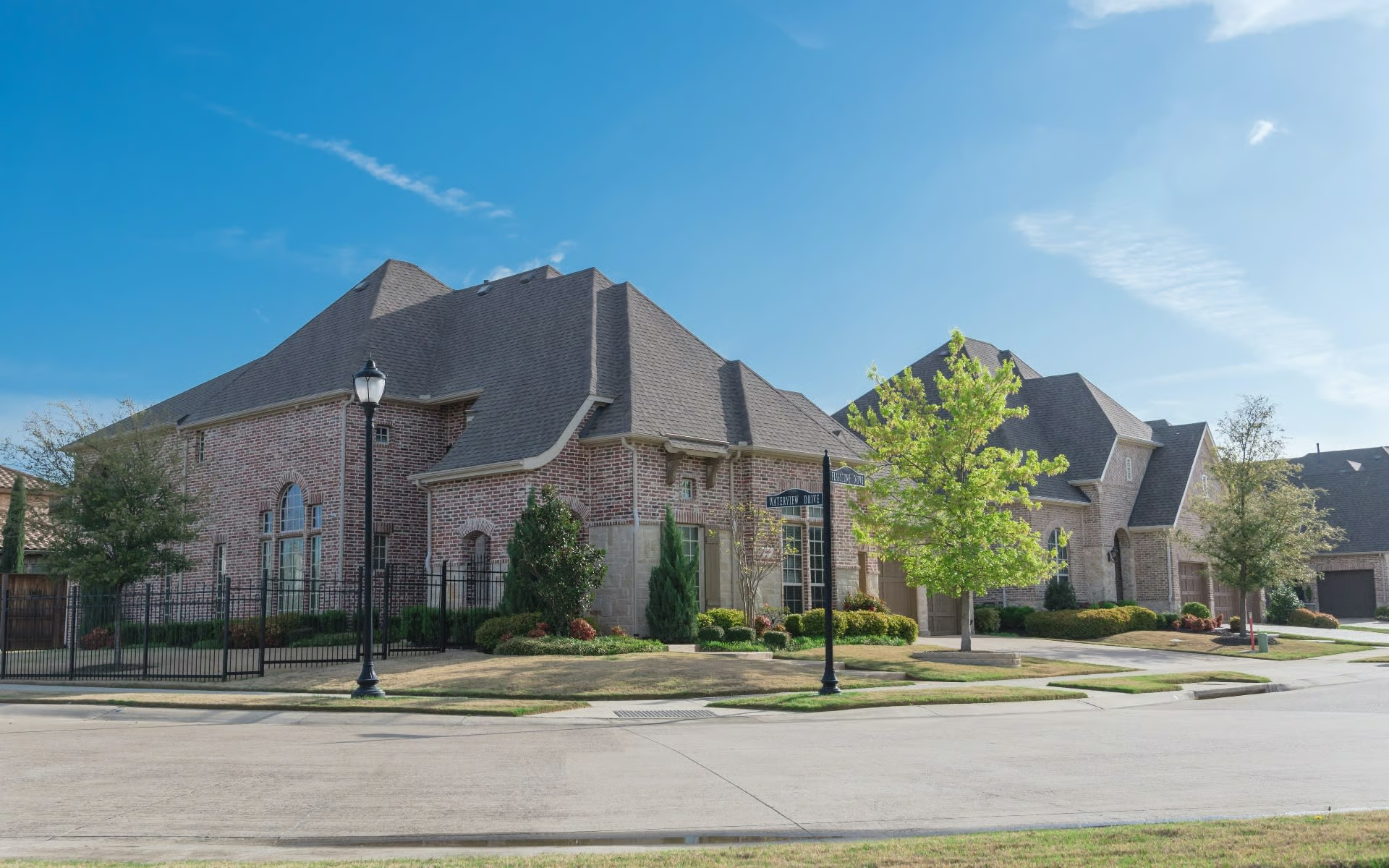
Are New Braunfels home prices dropping—or just shifting?
Quick Answer
March 2026 feels like a “choose-your-strategy” market in New Braunfels and the broader San Antonio corridor. Homes are taking longer to sell, inventory is closer to balanced, and buyers have more leverage—especially when a listing is overpriced or competing with new construction incentives. The win right now (for both buyers and sellers) is to stop reading the market as one big headline and start treating it as pockets: neighborhood, price band, condition, and builder competition.
The Complete Picture
If you’ve been watching the New Braunfels housing market (or the San Antonio metro) and thinking, “This feels different than a year or two ago,” you’re right. The story isn’t one simple number. It’s pace, supply, and negotiation. When homes sit longer and buyers have more choices, the market starts rewarding preparation and discipline instead of urgency.
That’s why I’m framing this week’s update around what actually changes outcomes: how long homes are taking to move, where buyers are finding leverage, and what sellers can do to protect equity in a market where buyers are comparing every option—including builder incentives—side by side. If you want help translating these signals into a plan for your specific neighborhood and price point, that’s exactly what Cody Posey Real Estate does every day.
Key Insights
Before we get tactical, here’s the big idea: in 2026, the “market” isn’t one market. It’s a set of micro-markets that move at different speeds. Use these insights as your decision framework—then narrow it down to your zip code, your price band, and your competition.
-
Pace is slower, and that changes leverage
When homes take longer to sell, buyers get time to be choosy—and sellers need sharper strategy. For the broader San Antonio-area context, February reporting indicated homes spent about 102 days on market on average, which is meaningfully longer than last year. That kind of timeline doesn’t mean “nothing sells.” It means buyers have room to negotiate when a listing is even a little out of position.
What to do with that: if you’re buying, don’t rush into the first house that’s “good enough.” If you’re selling, don’t assume traffic will fix pricing. You want a defensible value story on day one (price + condition + terms), because the buyer pool is comparing everything.
-
Inventory is near balanced (not a crash), so execution matters
In February, local reporting put inventory at a little more than five months in the San Antonio area—often considered close to balanced (a commonly cited benchmark is around six months). A balanced-ish market is a “process” market: the best-prepared, best-positioned listings win, and the best-prepared buyers negotiate smarter.
This is where a lot of people get tripped up. Balanced doesn’t mean prices free-fall. It means the market stops forgiving sloppy pricing and weak presentation. Sellers can still protect equity, but they have to earn it with strategy. Buyers can still overpay, too—usually by ignoring comps and getting emotional.
-
New Braunfels is segment-driven: resale vs. new build is a real fight
Public dashboards for New Braunfels in early 2026 show a market where the “median” can move as the mix of homes changes. One example: Redfin’s city dashboard has shown a February 2026 median sale price around $307,000 (about -5.5% year-over-year). That doesn’t automatically mean your home is down 5.5%. It means the middle of the market is being influenced by what’s selling—often including a large share of builder inventory.
In practical terms, resale homes need to compete with incentives: rate buydowns, closing-cost credits, and upgrade packages that make new construction math look attractive. Resale homes can still win—location, mature landscaping, established neighborhoods, and move-in timing matter—but you need to price and present in a way that makes the choice obvious.
-
Days on market is a “truth serum” for negotiation
For the San Antonio–New Braunfels CBSA, FRED (Realtor.com housing inventory metrics) showed a February 2026 median days-on-market figure of 79. When the typical home is sitting that long, buyers have a simple but powerful tool: time. Time to request repairs. Time to ask for credits. Time to walk away if inspection results aren’t workable.
The mini-example: if a home has been listed well beyond the local norm—and nothing about it is “unique in a premium way”—you can usually negotiate from a stronger position. Sellers: if your listing is drifting into that zone, it’s a signal to adjust pricing or terms before the market decides for you.
-
Rates may ease, but “affordability math” is still the driver
Texas market forecasting (TRERC) has pointed to 30-year fixed rates in the roughly 6.0% to 6.4% range in the later part of 2026. That’s better than the peak-rate environment, but it’s not the 3% era. In this range, buyers shop payments, not just prices—and that’s why credits and buy-down conversations matter more than they did when money was cheap.
So if you’re a seller, it’s not enough to say “prices are up long-term.” You need to make the monthly payment feel reasonable for your target buyer. If you’re a buyer, your advantage is clarity: you can set a hard monthly cap, compare incentives vs. price cuts, and negotiate based on what actually improves your payment.
Market Reality
Here’s what I’m seeing in real conversations right now: buyers aren’t desperate, but they are decisive when a home is clearly the best option at its price. They’ll move fast on a clean, well-priced listing—especially in the most livable neighborhoods and school zones—but they won’t “stretch” for something that feels like a compromise. That’s a key difference from the frenzy years.
Sellers, on the other hand, often come into March with two competing ideas: (1) “I want peak pricing,” and (2) “I want it sold quickly.” In 2026, you can still do really well, but you usually can’t do both unless your home is truly best-in-class. The market is rewarding homes that feel easy: clean condition, clear repairs, modern presentation, and a price that makes sense compared to the next three alternatives a buyer can tour this weekend.
And this is where the New Braunfels / Hill Country dynamic shows up: builder incentives. When new construction is offering credits or rate buy-downs, a resale listing that’s “only a little high” can feel wildly overpriced because the monthly payment comparison doesn’t care about your list price story—it cares about the buyer’s out-of-pocket cost and payment. That’s why my advice is always to price and negotiate using today’s competition, not 2021 memories.
Finally, remember the most important truth about market stats: they describe what already happened. Your job is to make the next decision the smart one. If you’re buying, you want to avoid overpaying for a home that will sit if you resell in a few years. If you’re selling, you want to avoid chasing the market with multiple reductions. A single, well-timed strategic adjustment early is almost always cheaper than a slow drip of price cuts later.
Action Steps
- Buyers: set your “payment ceiling,” then shop value. Pick a monthly payment cap you can live with comfortably. Then compare homes based on total payment impact (price + taxes + insurance + any incentives). If you want help running those comparisons quickly, start here: Cody Posey Real Estate.
- Buyers: use time-on-market as your negotiation trigger. If a listing is sitting beyond the local norm, that’s where credits, repairs, and price negotiation tend to be most realistic. Don’t negotiate just to negotiate—negotiate when the facts support it.
- Sellers: compete with today’s alternatives, including builders. Pull the three most comparable active listings and the most comparable new-build options a buyer would consider. If your home isn’t the best value, adjust price, presentation, or terms until it is. Your goal is to be the obvious “yes.”
- Sellers: protect your first 10–14 days. That launch window is when you have the most attention. If showings are weak or feedback is consistently “overpriced,” don’t wait 45 days for the market to punish you—make one decisive correction while you still control the story.
- Both: zoom in to micro-markets. The right question isn’t “Is it a buyer’s market?” It’s “What’s happening in my neighborhood, my price range, and my condition bracket?” You can browse general info at cposeyrealestate.com, but the faster path is a local comp-and-competition plan built around your exact address and goals.
Frequently Asked Questions
- Is New Braunfels in a buyer’s market right now? It depends on the pocket. Many segments feel buyer-friendlier than the peak years because homes are taking longer to sell and buyers have more choices—especially where new construction is heavy. But well-priced, move-in-ready homes can still move quickly.
- Are home prices dropping in New Braunfels in 2026? Citywide medians can be mixed because the “middle” changes with what sells (including new builds). Some dashboards show softer year-over-year medians, but the real answer is neighborhood + price point specific. The only reliable way to price (or buy) is by comps and current competition.
- How much can a buyer negotiate in today’s market? Negotiation tends to be strongest on listings that are overpriced, have been sitting longer than normal, or need repairs. Credits for closing costs or rate buydowns can be more valuable than a small price cut because they impact monthly payment.
- Should sellers offer concessions in 2026? Sometimes, yes—especially if affordability is the buyer’s main obstacle. A targeted concession (like a closing cost credit) can expand your buyer pool and shorten days on market. The key is to choose concessions strategically, not automatically.
- What’s the fastest way to know what my home could sell for? A comp-and-competition analysis that includes current actives, pendings, and nearby new construction incentives. If you want a straightforward plan (not a fluffy estimate), reach out to Cody Posey Real Estate and I’ll help you map the smartest pricing and negotiation approach.
Closing
If you’re weighing a move in 2026, the advantage goes to the person with a plan. Buyers win by protecting their payment, using leverage where the facts support it, and acting decisively on the right home. Sellers win by pricing for today’s competition, presenting the home like a product, and making early adjustments before the market forces them.
Ready to talk strategy? Call Cody Posey Real Estate at 830.360.5569.
Sources: Texas Public Radio (SABOR February 2026 recap): https://www.tpr.org/news/2026-03-11/san-antonio-housing-market-continues-to-cool • FRED (Realtor.com Housing Inventory Core Metrics, San Antonio–New Braunfels CBSA median days on market): https://fred.stlouisfed.org/series/MEDDAYONMAR41700 • Redfin New Braunfels dashboard (market snapshot): https://www.redfin.com/city/13081/TX/New-Braunfels • Texas Real Estate Research Center forecast (12 months ending summer 2026): https://trerc.tamu.edu/article/trerc-real-estate-forecast-12-months-ending-summer-2026/